
 Udeliť


Priemyselné správy
Domov / Novinky / Priemyselné správy / How Refrigeration Condensers Improve Heat Dissipation & Cooling Performance
How Refrigeration Condensers Improve Heat Dissipation & Cooling Performance
Uverejniť Správca | 25 Nov
A condensing unit that starts with an 8°C approach temperature can drift to 22°C after two seasons of dirty airflow, and every degree of rise pushes compressor power consumption up by roughly 2 to 3 percent. Refrigeration condensers improve heat dissipation and cooling system performance by transferring the heat picked up in the evaporator plus the heat of compression to ambient air or water. When that transfer slows, the entire system pays in higher discharge pressure, lower capacity, and reduced compressor life.
What a Condenser Actually Rejects
A condenser rejects two distinct heat loads: the cooling load absorbed at the evaporator and the equivalent heat of compressor work. In a typical R-410A air-conditioning system, total heat rejection runs 20 to 35 percent higher than the useful cooling capacity because the compressor adds its own input energy to the refrigerant stream.
Heat leaves the condenser in three progressive stages:
- Desuperheating - hot discharge gas enters at 70-90°C and is cooled to saturation temperature with no phase change.
- Condensing - latent heat is released as refrigerant vapor changes to liquid at constant pressure and saturation temperature.
- Subcooling - liquid refrigerant is cooled a few degrees below saturation to prevent flash gas at the expansion valve.
A refrigeration condenser is a heat exchanger that removes heat from high-pressure refrigerant vapor, condenses it to liquid, and subcools it before the expansion device, using air, water, or a combined medium as the heat sink.
Because the condensing stage releases the largest portion of rejected heat - commonly 70 to 80 percent of the condenser duty - small changes in condensing temperature have an outsized effect on overall cycle efficiency.
Four Variables That Set Condenser Capacity
Four variables determine how much heat a condenser can dissipate: effective surface area, airflow volume, temperature difference between refrigerant and ambient air, and internal cleanliness.
| Variable | Heat transfer mechanism | Field symptom when weak |
| Surface area | Larger area creates more conduction and convection paths | High approach temperature on undersized coils |
| Airflow | Higher face velocity raises the convective heat transfer coefficient | Blocked fins or failed fan blades can cut capacity by 30-50% |
| Temperature difference | Larger temperature difference accelerates exchange rate | Hot ambient conditions derate the condenser |
| Cleanliness | Dirt and scale act as an insulating layer on the tube wall | Approach temperature rises from 8°C to more than 20°C |
Designers size condensers for a nominal temperature difference, typically 10-15°C above ambient for air-cooled equipment. When field conditions push the actual temperature difference beyond that design point, the compressor works against higher head pressure and draws more current.
Air-Cooled, Water-Cooled, and Evaporative Condensers Compared
Air-cooled condensers dominate light-commercial HVAC because they need no water supply and little routine maintenance, but they run the highest approach temperature - typically 10-15°C. Properly sized fin-type coils use aluminum fins over copper tubes to maximize the air-side surface that rejects heat to the ambient.
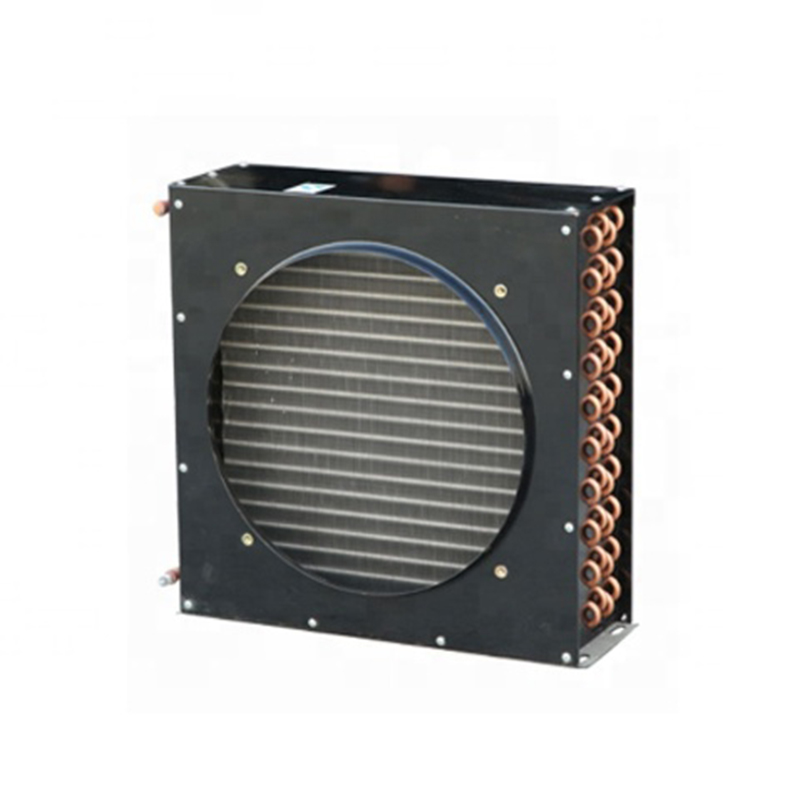 Fin Type Air Cooled Condenser with Double-Row Coil and Axial FanThis air-cooled condenser offers efficient fin-and-tube heat rejection with a low-noise axial fan, suitable for medium-to-high ambient conditions and flexible installation in light-commercial systems.View Product →
Water-cooled condensers work with approach temperatures of 4-8°C, which lowers condensing pressure and improves efficiency, but they add cooling tower and water-treatment costs. Evaporative condensers combine air and water spray to reach 3-6°C approach, making them the strongest choice for hot, dry climates where dry air-cooling suffers.
Air-Cooled
Lowest installed cost; no water required; approach 10-15°C; sensitive to ambient temperature and coil fouling.
Water-Cooled
Approach 4-8°C; stable condensing; requires water treatment and cooling tower; risk of scale and corrosion.
Evaporative
Approach 3-6°C; best hot-climate efficiency; higher maintenance; needs clean water and biological control.
For cold storage rooms, process cooling, and industrial duty, an industrial air-cooled condenser offers robust fin spacing and heavy-duty fans that tolerate dirtier environments than standard split-system coils.
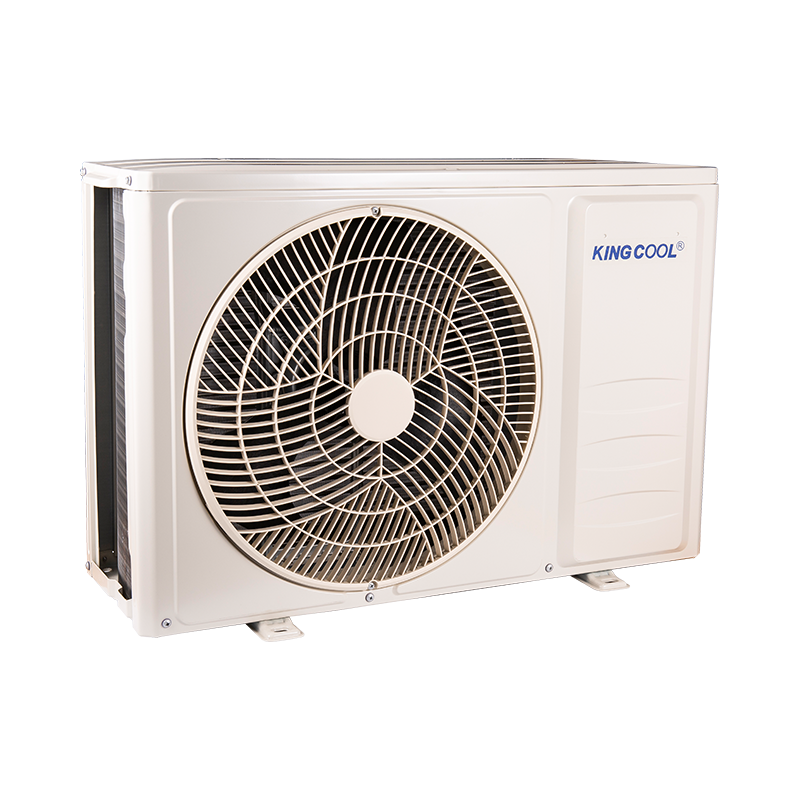 Industrial Air-Cooled Condenser for Cold Storage WarehousesDesigned for cold rooms and process cooling, this industrial air-cooled condenser features corrosion-resistant construction and series options for fresh, cold, and quick-freezing storage applications.View Product →
Quantifying the Efficiency Impact
A 1°C reduction in condensing temperature cuts compressor power draw by approximately 2 to 3 percent in most vapor-compression systems. That relationship makes condenser performance one of the highest-leverage maintenance targets in any refrigeration plant.
Typical condensing approach temperature by condenser condition: lower is better.
The same logic applies to water-cooled and evaporative units. Scale deposits as thin as 1 mm on a water-cooled tube can raise condensing temperature by 2-4°C, turning moderate condenser fouling into a measurable operating cost.
Restoring Heat Dissipation in the Field
Restoring a condenser to its rated heat-dissipation performance requires five actions: clean the coil, restore airflow, inspect fans, verify refrigerant charge, and confirm results.
- Clean both faces of the coil with a foaming condenser cleaner and rinse in the direction of the fins, never against them.
- Straighten bent fins with a fin comb and replace fin sections too damaged for repair.
- Inspect fan blades, bearings, and the run capacitor that feeds the fan motor - a weak capacitor slows the fan and directly reduces airflow.
- Confirm the condenser is not recirculating its own hot discharge air; maintain recommended clearance from walls and adjacent units.
- Measure approach temperature and liquid subcooling after cleaning, and compare them with the unit nameplate or manufacturer data.
Fan performance deserves special attention. Axial fans engineered for condenser duty move high air volume at low static pressure, and their condition directly sets the condenser's air-side heat transfer.
 Axial Fans Engineered for Condenser DutyThese axial fans are built for condenser applications, delivering high airflow at low static pressure to support effective air-side heat transfer and reliable system performance.View Product →
Combining a clean coil with a correctly charged system and matched fan replacement restores approach temperature faster than any single measure. Cleaning alone cannot compensate for an undersized or mismatched fan.
Follow documented refrigeration accessory maintenance practices to schedule these checks before the hottest months rather than after a high-pressure trip.
Symptoms of a Condenser That No Longer Dissipates Heat
A condenser that has lost heat-dissipation capacity produces a predictable cluster of symptoms that technicians can verify in minutes.
- Discharge pressure above the normal range for the current ambient temperature
- Approach temperature above 16°C on a clean-looking air-cooled coil
- Compressor current draw above nameplate rating
- Frequent high-pressure switch trips or short cycling
- Liquid line that feels excessively hot, indicating limited subcooling
When discharge pressure, approach temperature, current draw, and subcooling all point in the same direction, replace the faulty condenser component before it takes the compressor down with it.
When these signs appear together, the condenser - not the compressor - is usually the root cause. Replacing a healthy compressor without addressing condenser airflow guarantees the new compressor will fail under the same strain. If the coil or fan assembly is beyond repair, contact Ningguo Kingcool Import and Export Co., Ltd to discuss replacement condensers and condenser components with our team matched to the application.
Frequently Asked Questions
Why does a dirty condenser increase energy consumption?
Dirt and debris act as an insulation layer on the coil surface. The condenser cannot reject heat as quickly, condensing temperature and head pressure rise, and the compressor draws more current for the same cooling output.
What approach temperature indicates a clean air-cooled condenser?
For a clean air-cooled condenser in normal ambient conditions, the approach temperature - condensing temperature minus entering air temperature - should fall between 10°C and 15°C. Values above 16°C indicate fouling, airflow restriction, or fan degradation.
Can an oversized condenser improve system performance?
Yes, within reason. A larger condenser lowers condensing temperature and reduces compressor work, but it adds cost and can reduce refrigerant velocity in the coil, which affects oil return. Match the condenser to the system's actual heat-rejection duty rather than oversizing arbitrarily.
How often should condenser coils be cleaned?
Light-commercial units in clean suburban environments typically need cleaning once or twice per year. Industrial and food-service installations near grease, dust, or fibrous debris should be inspected quarterly and cleaned when the approach temperature rises more than 3°C above the baseline recorded at commissioning.


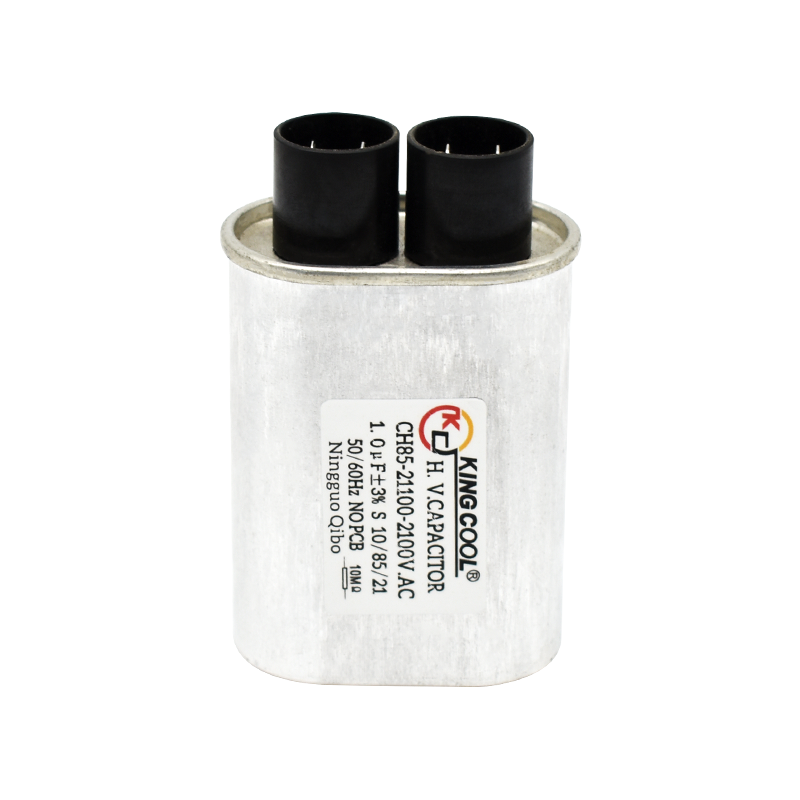


Efektívne nabíjanie, stabilný výstup, kondenzátor, prvý výber pre elektrický pohon.
- Address: Severná strana zóny Ekonomického a technologického rozvoja Helixi Ningguo, Anhui, Čína
- Phone/WhatsApp: +86-18110862602
- Email:
Prihláste sa na odber nášho bulletinu
Ak máte niečo na konzultáciu, môžete nás poklesnúť, budeme vás kontaktovať čo najskôr k dispozícii

Autorské práva © Ningguo Kingcool Import and Export Co., Ltd. Všetky práva vyhradené. Vlastné dodávateľy dielov a príslušenstva HVAC